
Analysis / Memory and identity
Other Worlds, Other Lives
The Strange Wooden Panel and the memory of the soul
In this article 9 sections
Full spoilers for Queen's Domain, including the Petrified Garden and Ending 4.
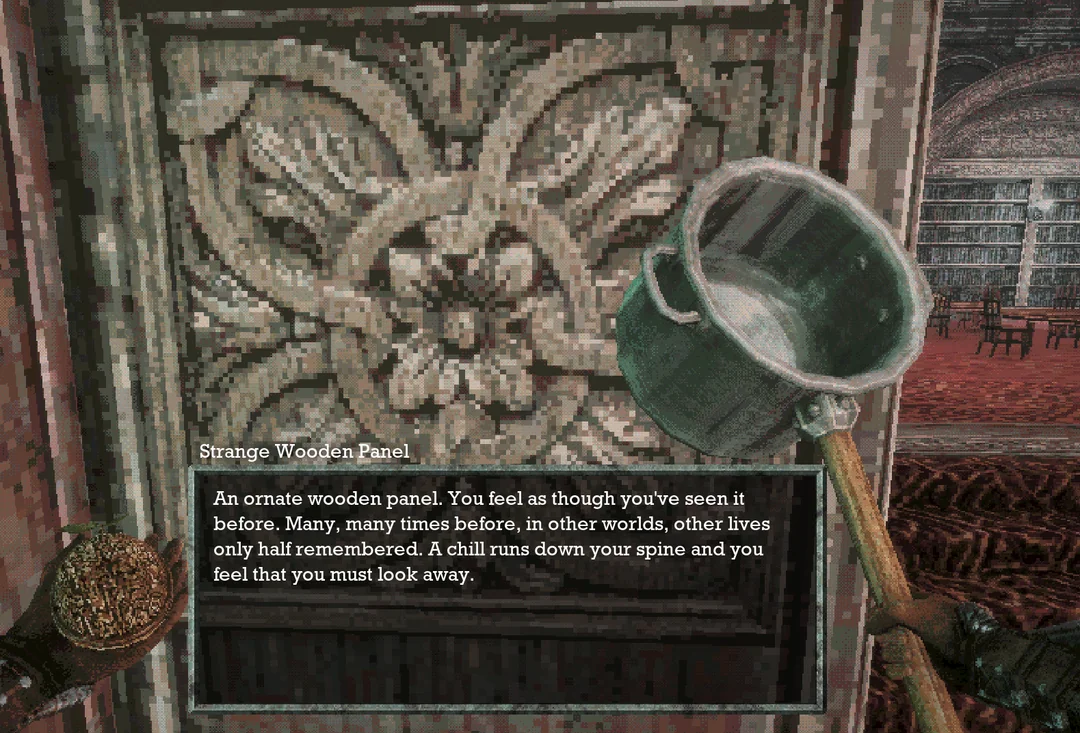
In the library of Siraatsu Castle, an ornate wooden panel interrupts the familiar work of exploration. Examining it reveals neither an inscription to decipher nor a history of its maker. Instead, the description turns inward, toward an experience Beruim cannot explain:
An ornate wooden panel. You feel as though you've seen it before. Many, many times before, in other worlds, other lives only half remembered. A chill runs down your spine and you feel that you must look away. [1]
The encounter is brief, but its implications reach into the game's treatment of death, memory, and identity. Throughout Neasied, Beruim discovers that the world has a history missing from the accounts he inherited. The panel raises a more intimate possibility: his own remembered life may be incomplete in much the same way.
Recognition without recollection
The wording carefully distinguishes a feeling from a recovered history. Beruim feels as though he has seen the panel before. He does not remember where, when, or as whom. Nevertheless, the impression is more specific than ordinary familiarity: it reaches toward other worlds and other lives, encountered repeatedly and only partly remembered. [1]
Recognition arrives without the life that would explain it.
That is the central mystery. The passage suggests continuity beyond the prince's familiar identity, but leaves the source of that continuity unnamed. His own earlier existence is one possible reading. An impression belonging to another consciousness is another. What the encounter directly presents is a familiarity he experiences as personal without being able to place it within his known past.
The carving offers no easy identification. Its face-like center and radiating, leaf-like forms give the recognition an object, but no accompanying text names the figure. The fear is similarly unexplained. Beruim feels that he must look away at precisely the moment something seems familiar. The scene stops at the threshold of recollection.
Recognition across games
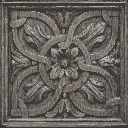
The description may also address the player’s memories. A decorative image encountered across fantasy games could feel familiar through different protagonists and different worlds. This reading places recognition in the experience of playing as well as in Beruim’s uncertain past.
One community discussion proposes a cathedral-pew photograph reused in other games, including Dark Souls’ Anor Londo. That remains an unverified provenance claim: an exact source photograph and a matching surface have not been established. Other participants compare the panel with the title or loading symbol and The Call From Beyond achievement art; those identifications also remain unverified. [25] [26]
The panel therefore leaves an in-world memory reading and a self-referential reading open. The sense of familiarity is explicit; a previous identity, shared fictional universe or literal cycle of all history is not established by these proposed resemblances.
Paradise, return, and the life after a life
A grave tablet in the Tower of Knowledge provides one of the clearest contexts for the panel's reference to other lives. Commemorating the dead Knowledge Keepers, it concludes:
May they rest peacefully in the paradise beyond until great god Wodaso returns their souls to us. [2]
The important word is until. The inscription looks beyond peaceful rest toward a return. For the community remembering these scholars, paradise is not necessarily the final separation between the dead and the living.
The monument at Deimpo Mausoleum presents a complementary division. Wodaso guides souls to paradise, while Puwema returns earthly remains to the sacred cycle. Soul and body have related but distinct destinations: one is guided beyond, while the other returns to the world below. [3]
The forbidden book Wodaso's Exile gives the prospect of return a stranger material setting. Goseus, Wodaso's avatar, travels deep beneath the world and constructs a moon containing enormous structures that house the dead's souls until they can be reborn. His work is described as both necessary and penance for continuing to use forbidden technology. [4]
These accounts have different purposes. The grave tablet is an act of remembrance; the mausoleum monument expresses religious assurances; the forbidden biography describes a hidden construction. Together, however, they show that the expectation of returning souls is not confined to a single obscure book. It also appears in the language used to honor the dead.
Within that setting, the panel's half-remembered lives become more than an isolated suggestion. A world that anticipates rebirth has room for a person whose history extends beyond one lifetime. The unresolved question is what, if anything, accompanies a soul when it returns. The panel's distinctive possibility is that some impressions might persist even when the life that gave them meaning can no longer be consciously recalled.
Other worlds are part of forgotten history
The phrase other worlds has its own foundation in the game's books. Another Home - Peha's Journey describes an earlier human homeworld, Peha's awakening after a long sleep, and her departure aboard a vessel to follow humanity. The Outer World describes a planetary surface far beneath the familiar world, with distant planets and stars beyond. Those accounts place humanity's present environment within a much larger history and geography. [5] [6]
Spirits From Fallen Worlds makes a different claim: the beings worshipped as gods are spirits from worlds that died long ago. Sipeha's bestiary entry supplies a specific example. She is a wandering soul from a distant world whose civilization disappeared hundreds of millions of years earlier, surviving in a fragment of memory recalling that world. [7] [8]
Travel between worlds and a spirit's survival beyond its original world are different forms of continuity. Both make the panel's language intelligible within the setting. Other worlds need not mean only imagined places, just as other lives need not mean ordinary episodes of the prince's current biography.
Beruim's reactions to the books make the comparison especially revealing. Peha's history sounds fantastical to him. The outer world's astronomy exceeds his understanding. When a book challenges the nature of the gods, he cannot bear to continue and calls it blasphemous. [5] [6] [7]
The panel produces a parallel retreat, but through familiarity rather than argument. The books describe a reality he struggles to accept; the carving makes him feel something he cannot explain. The implication is unsettling: his conscious beliefs may be narrower than either the world's history or his own capacity to recognize it.
The difference between preserving a past and understanding it
The Tower of Knowledge's own monument declares its purpose to be research and the archiving of knowledge. Yet one of its exhibits exposes the distance between possessing an artifact and understanding the civilization behind it. [9]
A stone model excavated beneath the tower depicts a city with walls so grand that no known city seems to match it. Its placard says the Royal Academy is investigating whether such a place ever existed. A conservator's note adds that, after months of restoration, the model was declared unsuitable for display and ordered into storage. The note does not explain the decision. [10] [11]
The city model and the wooden panel present opposite failures of recognition. The scholars possess a detailed representation but cannot place it within their history. Beruim encounters a carving that feels familiar but cannot recover the history that would account for that feeling.
In both cases, a trace survives while its context is missing.
This gives the panel a place within a larger pattern of environmental storytelling. Inscriptions, exhibits, and carvings are not merely containers for background information. They reveal how precariously the present is connected to what preceded it. Something can endure physically, institutionally, or perhaps within consciousness, without remaining fully understood.
What continues when the bearer changes?
The inscriptions recounting Muagyo's pilgrimage sharpen the question of personal identity. Upon Yubior's death, Jigeki's spirit joins his priestess Muagyo. Another inscription describes her mourning Yubior, whom she loved, even as she follows the god's will. [12] [13]
The distinction is crucial. Jigeki continues, but Yubior's death remains a loss. Muagyo's role as the new avatar does not erase her grief for the former one. These inscriptions distinguish the continuing god from the people through whom that god acts.
The Primeval Shrine offers another form of persistence. Its engraving calls for mementos of a warrior, adventurer, mother, scholar, sage, chef, artisan, and leader. The offerings preserve the particularity of the lives behind them: Wourha gives an ethereal hourglass, Gagi a chef's hat, and Gius a royal crown. Their work and identities remain meaningful after bodily death. [14] [15] [16] [17]
The setting therefore offers several distinct ways for something to survive: a soul awaiting rebirth, a god entering another avatar, or a spiritual gift carrying the association of a particular life. The panel does not specify which kind of continuity its recognition belongs to. Its language raises the question without deciding whether the remembered past would belong to Beruim as an individual, something he carries, or some other relationship between lives.
That uncertainty is part of its significance. Remembering a trace does not yet tell us who the rememberer has been.
The castle's uneasy relationship with memory
The panel is not the only text in Siraatsu Castle that makes memory unsettling. A servant's journal records cruelty, fear, and repeated desires to escape. After hearing that mechanical servants may replace the staff, the writer becomes unable to explain remaining:
I wanted to leave anyway, in fact I am quite unclear as to why I am still here now. I cannot remember? [18]
The final entry again reaches toward departure before breaking off: the servant cannot bear to remain, “and yet...” [18]
The experiences are not identical. The servant cannot account for an ongoing situation; Beruim cannot account for a sudden familiarity. Their shared setting nonetheless places two failures of self-understanding inside the queen's residence. One person cannot explain why they stay. Another cannot explain why something feels remembered.
It is possible to read these as part of the castle's oppressive atmosphere, where even the relationship between intention, action, and memory becomes uncertain. The texts do not establish a common cause, but they make the prince's reaction feel at home in a place where a resident already struggles to understand their own experience.
Forgotten memories and the temptation to inherit power
The Petrified Garden develops the uncertainty of memory on a larger scale. Its Silver Etched Skulls contain faint voices. The gate calls them forgotten memories and asks whose strange memories they might be. Once the collection is complete, it announces that the memories can be put into place and the ritual can begin. [19] [20] [21] [22]
The panel and the skulls share a question: what does a surviving memory mean when its owner or original context is uncertain? The skulls externalize that problem in objects that can be gathered. The panel brings it inward as something the protagonist feels.
Sipeha's remembered world gives the theme its most expansive form. Her memory preserves the setting of an extinct civilization as the place where her soul resides. A world can disappear while something of it continues through a surviving consciousness. [8]
Ending 4 then turns persistence into a threat. Sipeha's rune description characterizes her as taking until only cold, dark emptiness remains. After consuming her, Beruim's hunger for god-flesh is still unsatisfied. The victory leaves the world facing possible chaos. [23] [24]
Read together, these passages invite an ouroboros-like interpretation of destructive succession: the one who consumes the threat may continue something of its appetite. The recurring element would be a power or pattern passing into a new bearer. The panel's suggestion of continuity across lives belongs beside that interpretation, although it does not tell us that the same continuity explains both experiences.
The possibility is disturbing precisely because survival need not preserve a recognizable person. A memory, a spiritual power, an attachment, or an appetite might endure in different ways. The story repeatedly asks what the present inherits, and whether inheriting something also means becoming subject to it.
A buried history of the self
The Strange Wooden Panel brings the game's larger mysteries into a single private reaction. The grave tablet anticipates returning souls. The forbidden books describe earlier worlds and spirits that outlast them. The pilgrimage inscriptions distinguish a god's continuity from the death of its host. The mementos preserve the significance of individual lives. The skulls gather memories whose ownership remains uncertain.
Against that background, Beruim's recognition suggests a possible history that is neither written in an archive nor fully available to his conscious mind.
The clearest reading is not a recovered biography but a disturbance in the boundary of the self: for an instant, the prince feels familiar with something beyond the life he can remember. Whether that feeling belongs to an earlier incarnation, another consciousness, or a different kind of continuity remains the panel's unanswered question.
The world has a past that Beruim was never taught. The panel suggests that he may have one too.