
06 / Reference
Gods, avatars, and the survival of the self
In this chapter 8 sections
The distinction on which the plot depends
A god and an avatar are not interchangeable. An avatar can die or be defeated without ending the god's existence. Ending 2 states this explicitly: Siraatsu's defeat restores peace, but Sipeha can join a new avatar. The passage from Yubior to Muagyo gives the same principle a separate history within Jigeki's worship. A succession of bodies is therefore established; a succession of identical personalities is not. [44, 159, 160]
Religious images often depict an avatar rather than the god's underlying form. Puwema appears as Ruunen; Sipeha as Siraatsu; Jigeki as Yubior. Wodaso's scroll-bearing image has an unidentified human model, and the public description says the records of his avatars are lost or forgotten. The forbidden account of Goseus demonstrates that at least one such record survives outside the public account. This is a small, precise example of the game's central distinction between forgotten history and restricted history. [5 sources]
Puwema: fertility, remains, and selective remembrance

Puwema is described as a mother-goddess of nature and fertility. In the mausoleum inscription, she returns earthly remains to the sacred cycle while Wodaso guides souls. This presents decomposition and renewed growth as part of a benevolent order, not simply the corruption represented by hostile monsters. [3, 66]
Ruunen is the publicly memorialized ancient avatar, represented with a tree and winged tiara. Peha has a different biography and political legacy. The description of Ruunen says more recent avatars have not yet been memorialized, so public iconography preserves an older face of the goddess even as another avatar guides Beruim. [3, 61, 2]
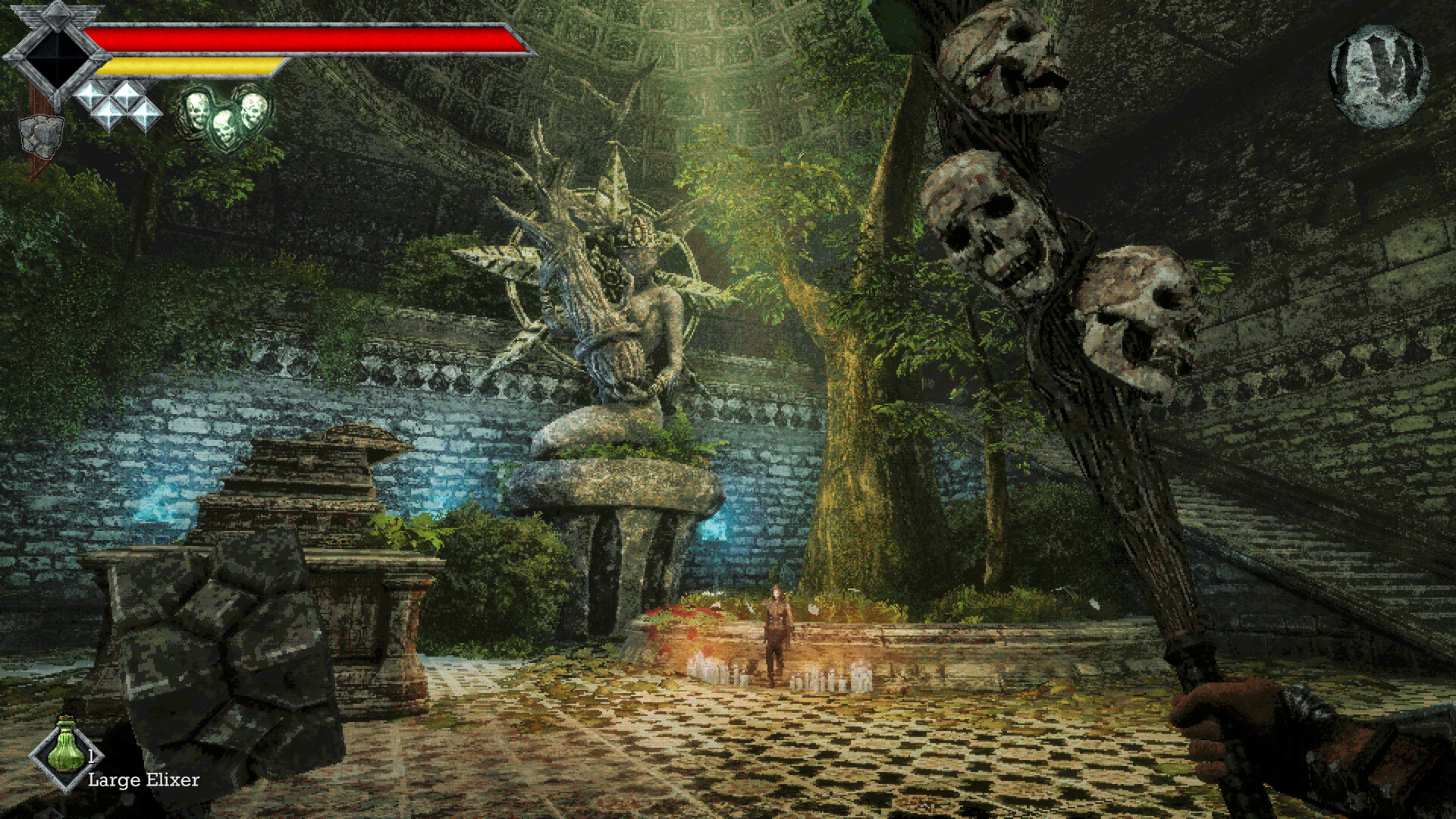
Peha's prohibition of technology explicitly elevates faith in Puwema and Wodaso. Puwema's influence therefore extends beyond healing and greenery: the authority of her avatar helps determine what future societies may know. The policy joins religious protection to control of historical knowledge. [9]
Wodaso: energy, wisdom, and the contradictory afterlife
Wodaso grants energy and wisdom. Public doctrine offers rules by which a soul may reach eternal paradise, while the narrator wryly observes how few believers obey them. The mausoleum similarly describes a final paradise. The forbidden account of Goseus instead describes souls housed until rebirth. [4 sources]
Paradise and rebirth coexist in the religious record, but their relationship is not explained. The public promise of a final destination and the forbidden description of an intermediate shelter leave a genuine uncertainty about the soul's journey.
Wodaso's power has practical uses as well as spiritual significance. Muojwi machinery can be powered by his lightning, while Goseus's construction places the care of souls within an engineered environment. His association with energy belongs to a world in which religion and technology interact. [73, 64, 163]
Jigeki: succession, decay, and concealed authority
Jigeki is associated with plague, rot, and death, but the history of the Obmuer shrines is also a story of affection, mourning, pilgrimage, and succession. Yubior's death and Jigeki's entry into Muagyo are more specific than a generic description of an evil cult. The Academy's continued veneration of Yubior obscures a living political and religious change. [4 sources]
The distinction between natural cycles and predatory cult practices matters. An account around Okmaru's pilgrimage presents Puwema and Jigeki as complementary, even though their followers can be fiercely opposed. The text therefore permits a relationship between fertility and decay without excusing Irdunuub's theft of Erma's eggs or Muagyo's encouragement of rebellion. [164, 14, 15]
Sipeha: the taking that leaves emptiness
The rune description characterizes Sipeha as taking until only cold, dark emptiness remains. Her bestiary entry reveals the ancient soul beneath that theological image, while her dependence on avatars explains why merely overthrowing the queen is insufficient. Her political threat and her cosmic origin are connected but distinct: an extinct civilization does not by itself explain why its surviving soul seeks domination. [59, 4, 44]
Sipeha's remembered world gives memory a spatial form: Beruim can enter and encounter the surviving recollection of an extinct civilization. Its landscape is both a battlefield and the last known trace of her distant origin. [4]
Okbujo: a power outside the familiar four
Okbujo is described as a godlike being in the Dekanima, a dimension of sentient, shifting metallic landscapes and alien life. The god's blessing allows a weapon to cross the barrier between an avatar and the divine being behind it. The silver herald prepares for Okbujo's coming and directs Beruim toward the offerings of familiar souls. [4 sources]
Okbujo gives Beruim a means of resisting a god, but the reason for that assistance remains unknown. The sword requires an offering of sufficiently powerful souls, represented in the forging by the absorption of the ethereal mementos. The precise relationship between those gifts and the donors' souls is one of the bargain's unanswered questions. [45, 165]
The Primeval Shrine's combined emblem echoes the four individual god symbols, placing the sword ritual within a broader visual language of divine power. Its specific theological meaning is unexplained. [166, 6]
Souls survive in more than one way
Ghosts preserve names, memories, affection, grief, and obligations. Goseus's structures house souls awaiting rebirth. Sipeha persists in a memory fragment. Josami Blood Angels regenerate their bodies and return after mortal wounds, but repeated passage through the other side alters their minds. The setting presents several distinct forms of survival beyond death. [6 sources]
The Blood Angels show that survival can transform rather than preserve a person. Siraatsu's enhancement ritual makes them difficult to kill and increasingly impossible to control. The twin lords Yuumed and Woyeki become so dangerous that the queen imprisons them; they continue killing and resurrecting each other, worsening with each death. [5 sources]
Recognition across lives
The Strange Wooden Panel in Siraatsu Castle makes Beruim feel that he recognizes it from other worlds and lives he can only half remember. Alongside the expectation that Wodaso returns souls from paradise, it raises a question about what a returning soul might retain. [295] [67]
That recognition is not a recovered biography. The panel leaves open whether the impression belongs to Beruim’s own earlier existence, another consciousness, or a different kind of continuity. Muagyo’s mourning for Yubior provides a useful distinction: a god can continue into a new avatar while the death of the previous bearer remains a personal loss. [159] [222]