
07 / Characters
The people of Neasied: lives, obligations, and mementos
In this chapter 11 sections
The eight offerings


The Primeval Shrine calls for offerings associated with a warrior, adventurer, mother, scholar, sage, chef, artisan, and leader. These roles correspond to eight people whose particular concerns Beruim encounters. The pattern makes his knowledge of the island's inhabitants part of the means of saving it. Treating the quest as eight anonymous souls loses much of its narrative design. [9 sources]
The gifts are ethereal objects associated with their donors. The Memento Mirror reveals nearby spirits when their quest conditions are met, allowing Beruim to speak with them and receive their offerings. [183, 184]
Gius Abraon: the failed king and the inheritance he leaves
Gius leads the expedition, fails with an incomplete holy weapon, and admits both his failure and his prior awareness of a hidden truth beneath the island. He leaves Beruim the fragments needed to move beyond that failure. His later gift is an ethereal royal crown, transforming the father's authority into a spiritual offering as well as a dynastic inheritance. [5 sources]
Ekonta and the company of knights
Ekonta initially tries to hold together a failing royal expedition. As a ghost, he refuses to depart without every member of his company. Once Beruim reunites them, he promises that they will watch over the prince and leads them toward the afterlife together. His memento, the royal crest, represents service and fellowship rather than battlefield success. [5 sources]
The individual knights make that collective resolution meaningful. Ippibi is wounded and later killed by the red-shelled beast while Beruim explores. Budaen's effort to aid the library contributes to its catastrophe. Nu flees with the supply key and dies under a collapse. Ujji is reanimated and turns against comrades, a consequence his ghost regrets. Each brings a different history of service, failure, or injury into the company's reunion. [6 sources]
Daon survives in a different condition: alive, but motionless and unable to speak. His silent presence adds another outcome to the expedition's losses. [188]
Aganmi and the Iryupe Raiders
Captain Aganmi's wrecked expedition offers a less respectable counterpart to Ekonta's. He worries about Onbi, Etne, Idpo, and Umpa, and asks Beruim to account for the missing crew. Their ghost accounts recall drowning or washing ashore, entrapment, violent injury, and poisoning. Each adds a separate fragment to the history of the wreck. [6 sources]
Aganmi ultimately establishes a small memorial and hopes his crew have made peace. He then imagines the next adventure beyond death, still in the language of treasure. His ethereal raider necklace preserves his identity rather than erasing it through a sudden moral conversion. The quest allows affection, guilt, opportunism, and humor to coexist. [194, 195, 176]
Wourha and Inha: a tragedy distributed across three kinds of text
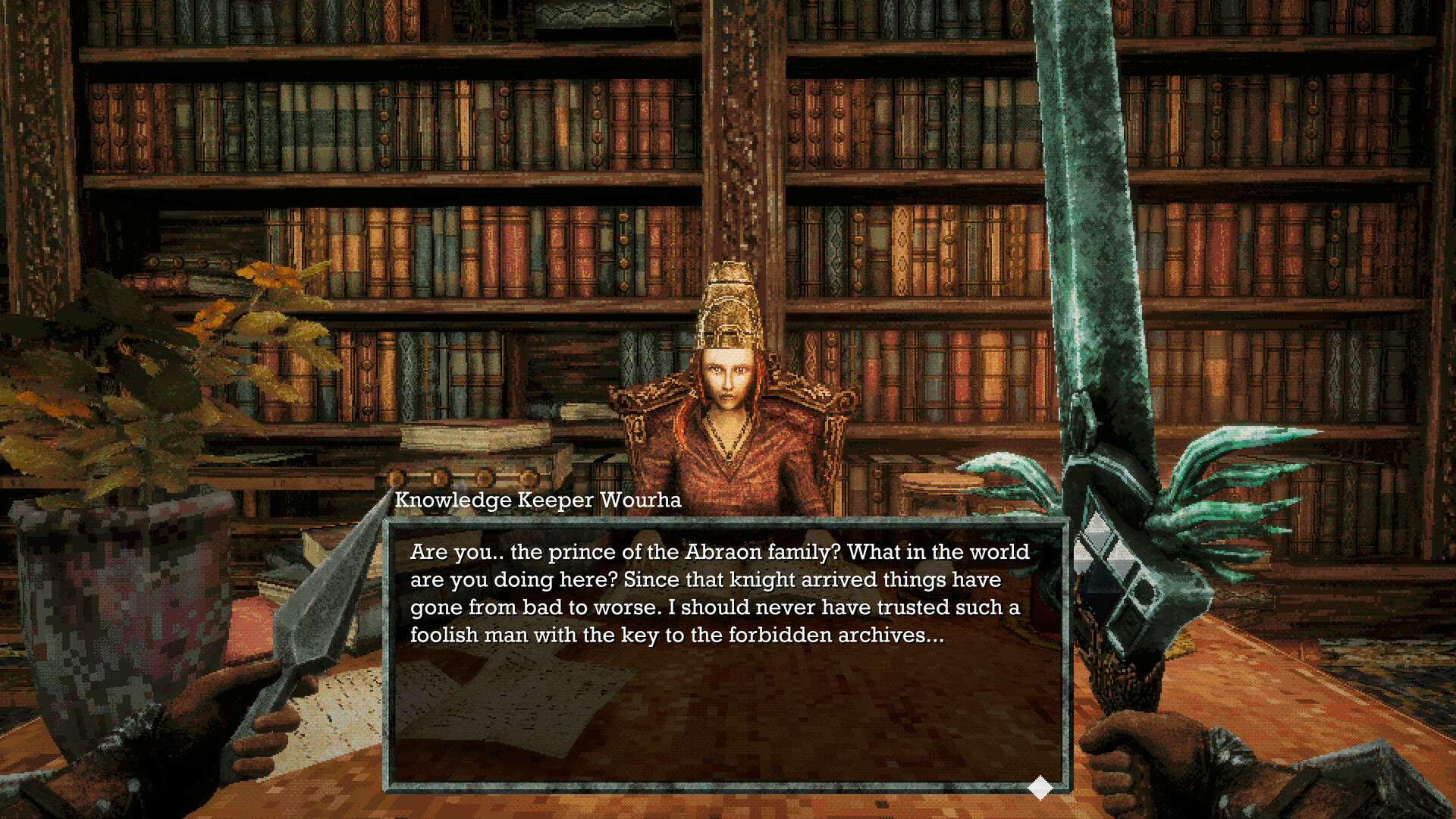
Wourha's bestiary is her life's work, but her story is also about a desired future with Inha. Their book exchange becomes a fatal misunderstanding. Inha reads the grim book Wourha has lent her as evidence that their hoped-for arrangement is not mutual. Despite a warning, she speaks an incantation and is reduced to bones. Her diary and enemy description supply the context that Wourha's initial dialogue alone cannot. [4 sources]
Wourha's own dialogue does not support Inha's pessimistic conclusion. She expects a future with her. After the research is finished, Wourha's ghost jokes that she worked too hard, trusts that the Academy will retrieve the papers, acknowledges Beruim's help, and announces that someone awaits her on the other side: Inha. The emotional resolution concerns both the completed bestiary and a relationship that ordinary life will no longer fulfill. [4 sources]
Her hourglass memento associates knowledge with finite life. Her inherited weapon adds another layer: the claws are a family heirloom linked to her mother's eastern origin. She is not only a quest-giving librarian but a person whose scholarly vocation, family history, and private hopes survive in different classes of description. [178, 204]
Wourha's joke about overwork places dark humor beside a serious conclusion: she leaves behind the research that will preserve her name and turns toward the person with whom she hoped to share her life.
Gagi and En: nourishment, prophecy, and recognition
Gagi prepares food for a hero foreseen in a vision. He does not recognize Beruim as that hero, even after the prince has benefited from his efforts. His crow En does understand. Afterward, En explicitly says Gagi's spirit is fulfilled because Beruim appreciated his cooking, while Gagi still imagines helping the unknown hero and continuing to cook in the beyond. [4 sources]
En’s saddle explains how Gagi’s vision takes physical form across the island. He rides on her back to deliver his meals, and his arrival calls attention to the food before he flies off to continue the work. The nourishment Beruim finds throughout Neasied is part of the chef’s preparation for the hero he has foreseen. [355] [356] [33]
The story gives feeding someone a place beside holy swords and cosmic rituals. Gagi's ethereal chef's hat belongs among the offerings that permit a divine confrontation. His story also creates a thematic contrast with Ending 4: nourishment first enables care and shared purpose, while the final divine meal leaves an unsatisfied appetite. [180, 52]
Erma: a mother who does not move on
Erma's eggs are stolen and scattered by Irdunuub's congregation. Beruim retrieves them, apparently restoring a future for the family. The first hatchling instead destroys the other eggs to secure its own position; its description says Jigeki's influence was already present in the egg. The quest's completion delivers the catastrophe rather than preventing it. [4 sources]
Erma's ghost admits that her divination did not foresee the betrayal and says she cannot leave the eggs. Her memento is an ethereal Orbewa fetus, and its description explicitly says her spirit still weeps. The gift preserves a mother's attachment to a future that has been destroyed. [210, 170, 177]
Her inclusion changes the meaning of the memento collection. Beruim does not receive gifts only from lives he has neatly repaired. He carries testimony from suffering he could not resolve.
Peha: the awakened guide
Peha's biography includes a long sleep on another world. Her present dialogue again describes being awakened, tired, and ready to rest. Across the immense interval between her victory over Siraatsu and Beruim's arrival, sleep and awakening remain recurring features of her story. Whether her present appearance involves prolonged survival or a return from death remains unresolved. [2, 138, 211]
After Peha completes her role, her ghost appears above the large coffin. Her corpse is staged inside it in the post-quest scene. The chamber gives her final rest a physical place within the mausoleum. [213]
Her memento, an ethereal symbol of Puwema, fills the sage's place in the shrine's sequence. The stained-glass flower above the coffin is also associated with Puwema, placing both the guide and her resting place beneath the goddess's imagery. [179, 214]
Ossi: knowledge pursued beyond judgment
Ossi collects data to revive an enormous suited human found floating in the black waters below his lab. The explorer's suit and weapon resist identification even by someone familiar with ancient technology. Ossi hopes that revival will let him learn more. His unfamiliarity with House Abraon, encountered in a weapon schematic, further emphasizes the distance between his technological world and surface society. [4 sources]
The experiment succeeds at revival but ends in a fatal encounter. The awakened explorer attacks Ossi; a dedicated scientist actor and kick animation stage the assault. Ossi's ghost protests the repayment he has received and tries to console himself that discovery was about the journey. His curiosity has achieved its immediate goal at the cost of his life. [7, 217, 218]
His memento is a mechanical arm, an ethereal token of the craft and curiosity that defined his life. [181]
Umbada and the people outside the eight-part pattern
Umbada's shop connects the island's expeditions through trade in recovered objects. Their modified mechanical guard illustrates the practical reuse of ancient technology, while their reaction to an unexpected arrival reveals their dependence on the travel network. Business and improvisation continue even amid the island's collapse. [219, 220]
Unfinished lives
Obligations, attachments, and the recognition of a completed life shape when and how the dead depart. Ekonta gathers his company; Gagi fulfills a prophecy through cooking; Wourha completes her work; Aganmi honors his crew. Erma remains bound to her loss. Together, these encounters make the mementos a record of lives Beruim has touched, including both fulfillment and grief. [6 sources]