
03 / History
The forbidden centuries: war, the moon, and historical erasure
In this chapter 5 sections
Goseus and the moon
A forbidden biography describes Goseus, Wodaso's avatar, exiled for continuing to use prohibited technology. Deep beneath the world, he constructs something called the moon and builds enormous structures inside it to house dead souls until rebirth. The work is described both as necessary and as penance. It belongs after the technological prohibition in the most natural reading, but its exact date relative to the great war is unknown. [64]
The moon joins constructed infrastructure to the passage of souls. Its stated purpose is to shelter the dead between lives, making the afterlife part of the world's concealed material history as well as its religious teaching.
Public doctrine describes Wodaso as guiding souls to paradise, while a Tower of Knowledge memorial speaks of his eventually returning them. Thus reincarnation is not found only in the most forbidden account; the concealed part is the moon and its infrastructure. [65, 66, 67]
The great war
Muojwi rises against Epha in a centuries-long conflict involving all the kingdoms. Epha allies with Bamaen; Muojwi allies with Ommu. The forbidden account supplies the crucial omitted fact: Muojwi armed itself with technology recovered from beneath the world despite Peha's prohibition. Public accounts remember Epha's costly victory and the eventual fall of both Epha and Muojwi, but largely erase the technological element. [10, 11]
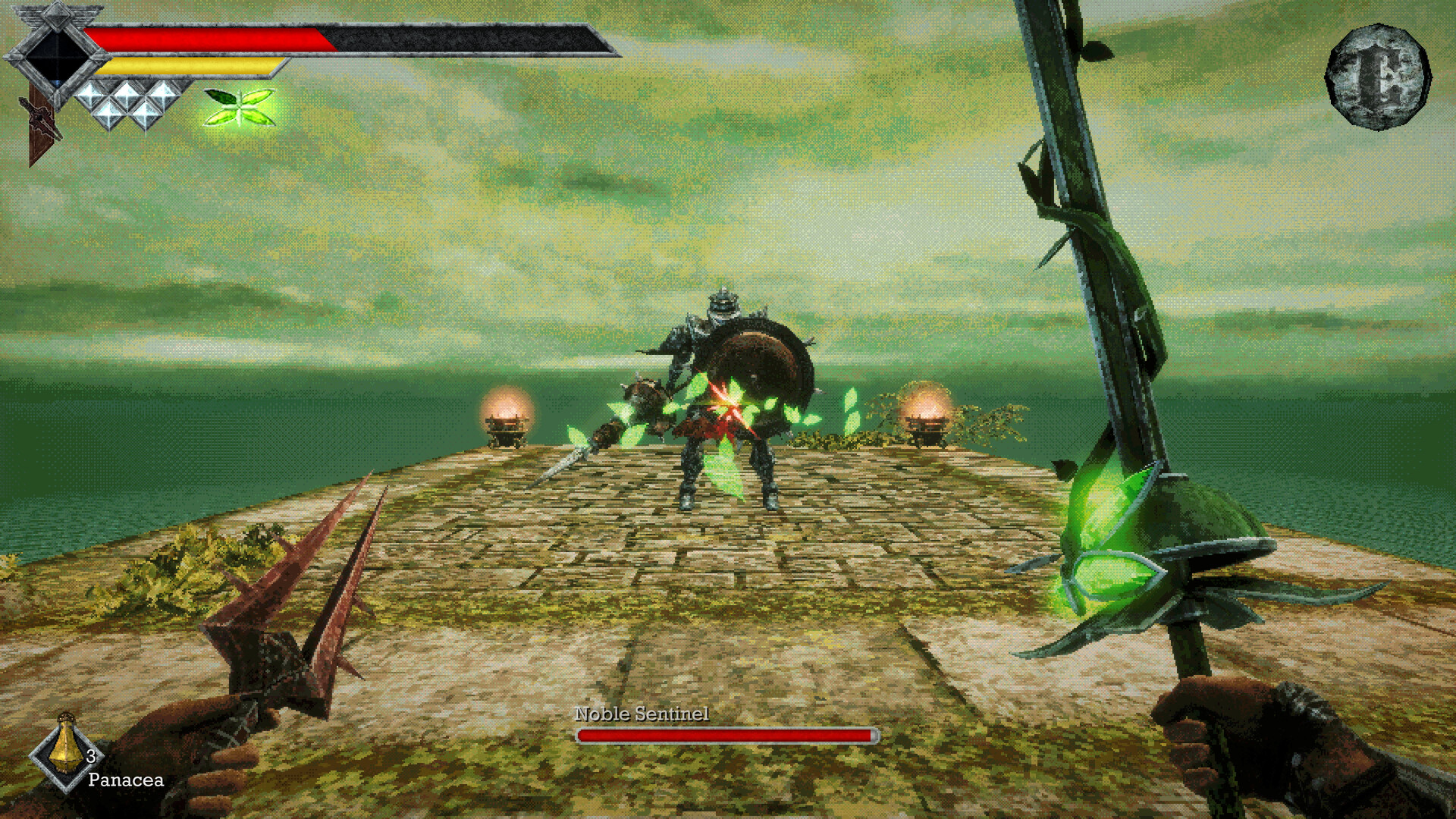
Weapons make the war tangible. Muojwi mechanical knights used crushing lances to drill subterranean invasion routes. A still-functioning knight guards a forbidden key above the mausoleum. Epha stone weapons, an aquatic hammer given to the Orbewa, and Gius's ceremonial spear preserve the counter-alliance through their materials and dedications. A stone casing conceals a Muojwi mechanical cube empowered by Wodaso's lightning, complicating any simple equation of one civilization with one god. [6 sources]
Epha's largest surviving legacy is infrastructural. Its Crystal Monuments restore weary travelers and ward off evil; its Wing Altars permit travel across the landscape. They were constructed throughout Bamaen and its surrounding islands during the war. What Beruim experiences as routine navigation is the still-operating legacy of a vanished military alliance. [74, 75, 76]
The Petrified Garden's founding
After the war, Ojjama, an ancient Orbewa king, gives up his title to guard the Petrified Garden. He works with the Epha to construct it around a forgotten remnant capable of threatening reality if uncovered. A crowned stone homopiscium in the Garden explicitly honors the Epha-Orbewa collaboration. The Orbewa therefore have an ancient history extending well before their recent emergence onto the surface. [12, 77]
The identity of the contained remnant remains unknown. Its survival gives the Garden a purpose extending beyond the kingdoms that fought the war: the political conflict has ended, but one of its dangers still requires a guardian.
Ommu's later war with Bamaen
Ommu, a participant in the ancient alliance, fights Bamaen again a few centuries before the present and suffers another defeat. Prince Emdaer's weapon and a defeated Ommu soldier's prison note preserve its human aftermath. The weapon legend says Emdaer abandoned his hammer and cast himself into the sea; the prisoner recalls seeing the prince fall before the army surrendered. Together they preserve an image of defeat and despair, although their precise sequence is uncertain. [78, 79, 80]
Institutional memory and institutional concealment
The Royal Academy builds the Tower of Knowledge, studies artifacts, preserves books, and commissions Wourha's bestiary. It also suppresses Muagyo's avatar status and orders a painstakingly restored model of an ancient city hidden from public view. Its scholarly and restrictive functions coexist within the same institution. [5 sources]
Interpretation: the civilization's ignorance has several causes. Some knowledge is lost; some survives behind barriers; some is actively withheld. Sincere scholars such as Wourha work within an institution whose role combines preservation with restriction.