
11 / Ritual
The Petrified Garden and the ritual of forgotten memories
In this chapter 9 sections
Why the entrance matters
The history of Epha places two clues in the same passage: the Epha built the Crystal Monuments and Wing Altars, and their hidden garden beneath Neasied can be reached by a leap of faith. During teleportation, Beruim remains on the platform while the surroundings become a dark, static-like sky. Stepping off leads into the Garden. The entrance turns the historical clue into a physical act. [76, 252, 242]
Interpretation: the builders of the travel network hid their containment site outside the network's ordinary use. Beruim abandons the safe route to reach a place excluded from everyday movement. The entrance makes the Garden a threshold experience even while the written history locates it beneath the island.
Ojjama and the danger that survived the war
Ojjama, once king of the Orbewa, relinquished his title to guard the Garden. Its construction with the Epha followed the Muojwi war and served to contain an unnamed remnant capable of threatening reality. Crowned stone homopiscia preserve the memory of the collaboration, giving the hidden sanctuary a place in both peoples' history. [12, 77]
The ritual lies within this history of containment. Its relationship to the imprisoned remnant is therefore one of the Garden's central questions, alongside the ownership of the recovered memories.
The gate asks for memories, not just a currency

The silver skulls are etched, plated remains containing faint voices. The gate asks for them as forgotten memories, wonders who those strange memories belong to, and describes its own long confinement as purgatory. After all the skulls are gathered, it says the memories can be put in place and the ritual can begin. The uncertainty about ownership is part of the dialogue itself. [6 sources]
The gate's plural voices describe their long confinement as purgatory. The completed collection brings 69 skulls together, allowing the memories to be put in place and the path to the ritual to open. [254, 47, 6]
A corridor of images
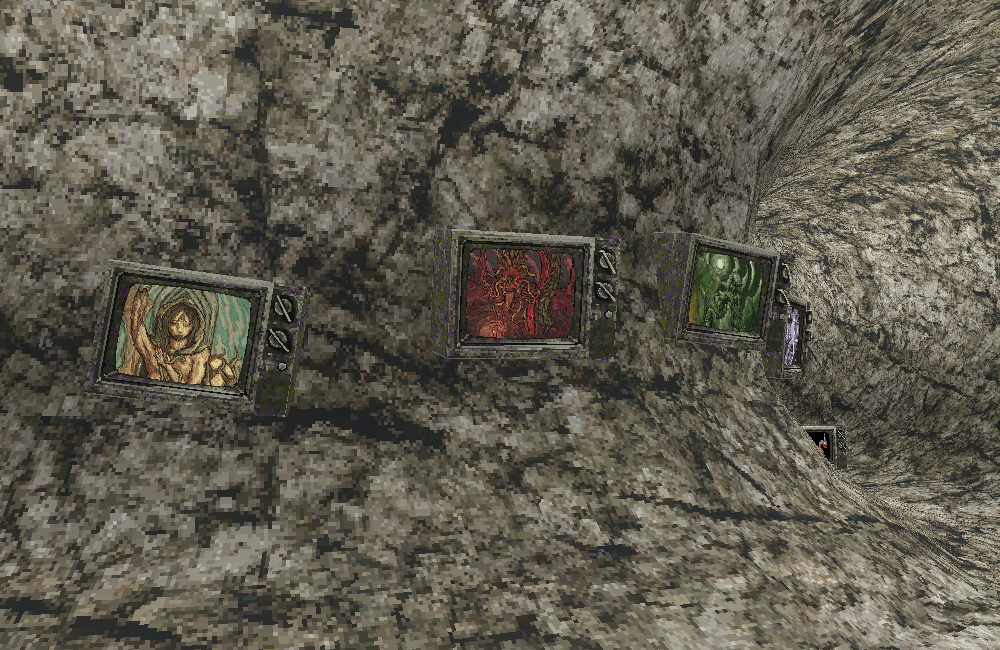
The corridor contains 46 televisions, each displaying a distinct source image through a shared screen effect. Together they form a spatial gallery of figures, landscapes, structures, and abstract forms. Their placement is recorded, but the images have no established chronological reading order. [255]
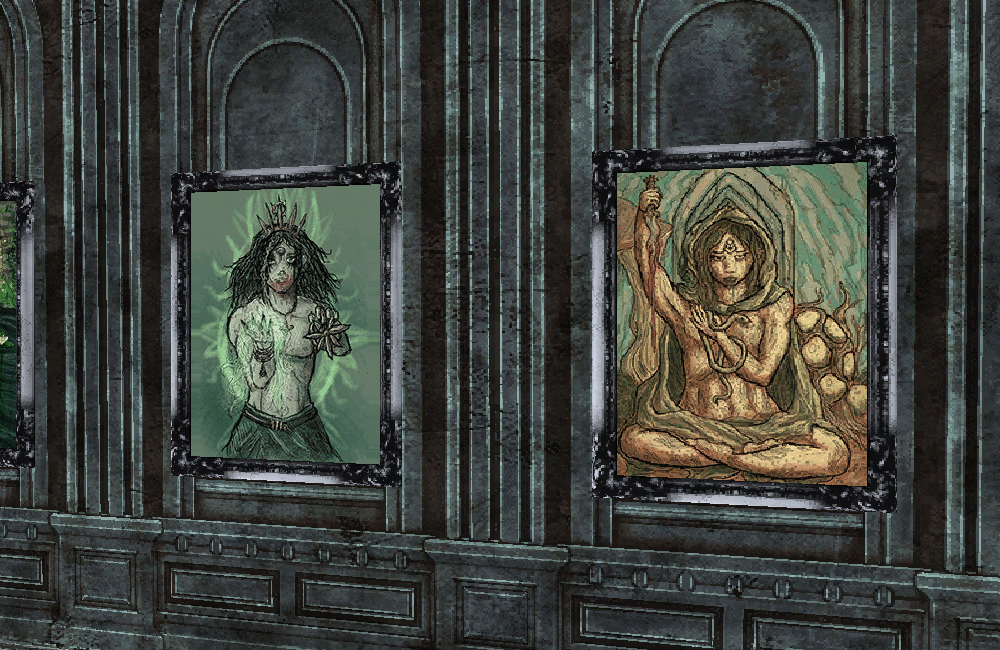
Several images repeat compositions displayed as paintings in Siraatsu's castle. Their recurrence brings the royal interior and the hidden memory-gallery into a shared visual language. The figures and scenes remain unidentified, leaving their historical relationship open. [256]
The ritual sequence
The cinematic raises Beruim approximately 3.35 metres during its opening sixteen seconds. Fifty cords break progressively while sixteen phrases appear. A descending, contracting substance closes around his body. The final word appears separately: “eat.” The sequence's stored playback duration is 195.2 seconds. [48, 49, 50]
“projected fears”
“from decayed hearts”
“fool's perception”
“whore's conviction”
“poison tongues”
“and rotten minds”
“turned a blind eye”
“with barren emotion”
“stolen accolades”
“living a lie”
“false proclamations”
“distorted decrees”
“perverted wisdom”
“of parrot sages”
“consort of sycophants”
“on thrones of delusion”
“eat”
The complete order is preserved in the recovered text and sequence. The gap before the final imperative is part of its staging, not an omitted seventeenth stanza. [18 sources]
The poem condemns deception, false authority, borrowed prestige, and corrupted wisdom. Those subjects fit the setting's censored histories and compromised institutions. But the speaker and target are unnamed. It could condemn the prevailing order, Beruim's assumptions, some older authority, or more than one of these. Its apparent insight is not a guarantee of benevolence: the denunciation culminates in an instruction to consume, not an explanation of whom that consumption serves.
The chamber after the ritual
The ritual breaks the fifty cords and replaces the connected skeletal figures with fifty differently posed skeletons. Associated lights, decals, and fog disappear; the remaining illumination dims and the sky fades. The chamber's lasting condition is one of severed connections and altered remains. [49]
The staging gives severance a central place in the ritual. Whether it releases, gathers, or otherwise changes what was bound to those remains is left unexplained.
Beruim's transformation
The substance enveloping Beruim is a purpose-built cinematic mesh with its own material and effects. It descends and contracts around his floating body as the ritual progresses. The recovered sequence identifies its movement precisely, while leaving the substance's nature unnamed. [50]
The sequence presents an initiation: Beruim rises, the cords are severed, the substance envelops him, and the word “eat” appears. The new capacity that follows makes this encounter the decisive preparation for the fourth ending.
Three scenes share the same cosmic visual resources
The ritual sky, Sipeha's remembered-world sky, and the transformed eyes in Ending 4 reference the same three textures: phone_Goop_TX, phonesky_top_TX, and SkyStarsTempRT_Tex3. The body coating uses a separate material. [274]
The shared resources establish a visual continuity between the ritual, the divine encounter, and Beruim's final appearance. Cosmic scenery becomes part of the protagonist's own presentation, reinforcing the transformation expressed by the ending.
The decisive causal link
Completing the ritual writes SkullRitualCompleted = 1. Sipeha's final interaction checks that state: without it, the interaction proceeds to banishment; with it, a dialogue choice can offer eating. The eating option has its own equality check for that flag and invokes the ending action. This link is confirmed technical evidence, not an inference from similar words. [51]
The two rites give Beruim different forms of access. The eight mementos enable Okbujo's Judgement and the confrontation beyond Siraatsu; the skull ritual enables consumption after that confrontation. The first is tied to the offerings of known people, the second to memories whose owners remain anonymous. [6, 165]